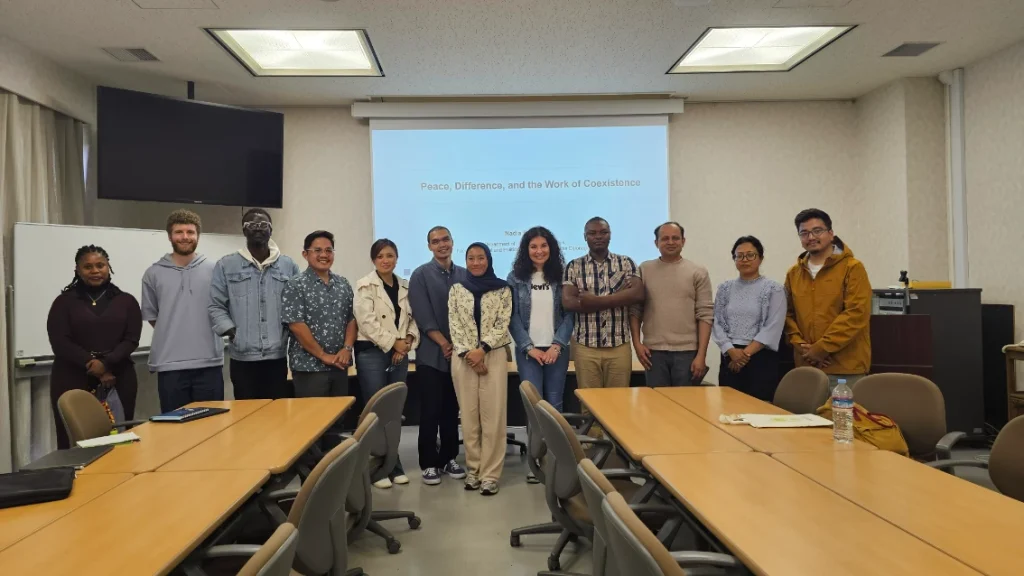
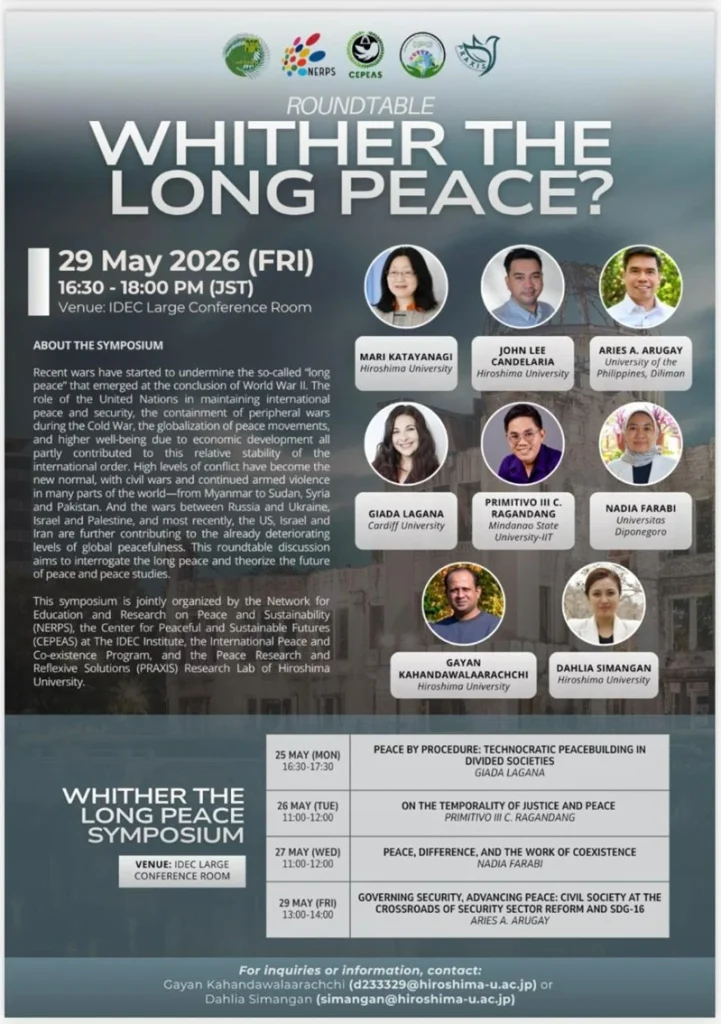
Dr. Nadia Farabi, a lecturer in the Department of International Relations, FISIP, Diponegoro University, and also the Coordinator of the International Undergraduate Program in International Relations, conducted an academic visit to Hiroshima University, Japan, as part of the International Staff Mobility program supported by Diponegoro University’s World Class University Program. This activity took place from May 25 to 31, 2026, including participation in the International Symposium “Whither the Long Peace?” at Hiroshima University, Higashi-Hiroshima, Japan.
This symposium was organized by the Network for Education and Research on Peace and Sustainability (NERPS), the Center for Peaceful and Sustainable Futures (CEPEAS) at The IDEC Institute, the International Peace and Co-existence Program, and the Peace Research and Reflexive Solutions (PRAXIS) Research Lab of Hiroshima University. This forum brought together academics and peace studies experts from various countries to discuss the relevance of the concept of “long peace” amidst increasing armed conflicts, geopolitical tensions, and various forms of structural violence at the global level.
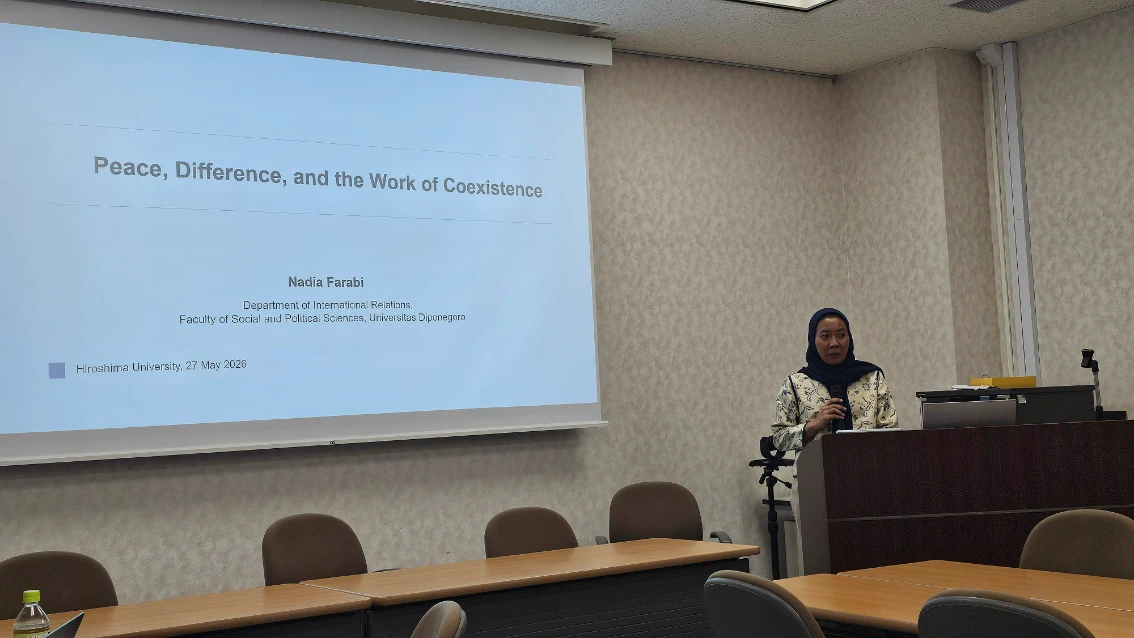
During the event, Dr. Nadia was a speaker in the IPC Seminar on May 27, 2026, with a presentation entitled “Peace, Difference, and the Work of Coexistence.” This presentation highlighted that peace cannot only be understood as the absence of war or the cessation of violence but also as a social, political, and institutional process that must be continuously built and maintained. Using the Indonesian experience as a point of reflection, the presentation discussed how religiously and culturally diverse societies can manage differences peacefully while also showing how differences can become sources of exclusion in certain contexts.
In addition to being a speaker in the IPC Seminar, Dr. Nadia also participated as a speaker in the Roundtable: “Whither the Long Peace?” on May 29, 2026. This session brought together international academics from Japan, the Philippines, and the United Kingdom to discuss the future of peace studies amidst an increasingly uncertain global situation. Her participation was an important contribution to bringing Indonesian and Southeast Asian perspectives into the global peace discourse.
This academic visit also served as a momentum to strengthen international cooperation networks between Diponegoro University and Hiroshima University. One important agenda explored was the initiation of cooperation with the Department of Integrated Global Studies (IGS), Hiroshima University. IGS is a four-year international undergraduate program conducted in English that integrates arts and sciences, emphasizing cross-cultural communication competencies, interdisciplinary perspectives, and the ability to collaborate in responding to global issues.
In her capacity as Coordinator of the International Undergraduate Program in International Relations, FISIP Undip, Dr. Nadia also discussed opportunities for student exchange cooperation for undergraduate students, particularly to support the launch of the program in the 2026 academic year. This exploration is expected to open up opportunities for international academic mobility for students, strengthen cross-cultural capacity, and support the internationalization of learning within FISIP Undip.
In addition to attending seminars and academic discussions, participants also visited the Hiroshima Peace Memorial Museum. This visit provided important reflections on collective memory, war trauma, and the commitment to peace that the people of Hiroshima continue to nurture.
Through this activity, Diponegoro University strengthens its commitment to encouraging internationalization, enhancing academic reputation, and expanding global research networks. This International Staff Mobility activity is expected to provide sustainable contributions to the development of International Relations studies, particularly in the fields of peace, coexistence, and diversity governance, while also supporting FISIP Undip’s readiness in developing international programs at the undergraduate level.